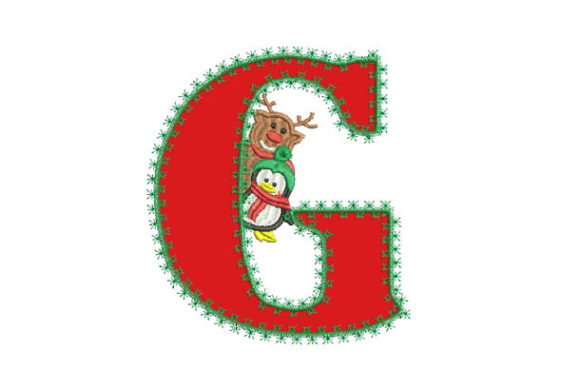
Christmas Letter G: A Designer's Review for Branded Merch
As an embroidery designer who spends most of my days digitizing logos and prepping files for commercial production, I approach every new machine embroidery design with a critical eye. It is not just about whether a pattern looks pretty on a screen; it is about how it translates to fabric, how it holds up under the needle, and ultimately, how it serves a brand. Today, I am reviewing the Christmas Letter G, a file marketed as a beautiful design for the holiday season. While many buyers might see this simply as a way to decorate a home pillow or make a personal gift, I am evaluating its potential as a core asset for small business merch, branded patches, and professional apparel.
First Impressions: Visual Personality and Brand Fit
Upon reviewing the product description, which highlights a "delicate design" ideal for Christmas gifts, my initial assessment leans toward an aesthetic that is elegant, classic, and slightly decorative. For a small business owner—whether you run a boutique bakery, a florist shop, or a creative studio—the visual personality of your branding elements matters immensely. The Christmas Letter G appears to carry a sense of warmth and tradition. It does not scream "corporate" in a sterile way; instead, it suggests a handmade product feel that resonates well with customers looking for authenticity.
For brands that rely on a rustic or premium handmade presentation, this type of lettering can be a powerful tool. It feels friendly yet refined. However, because the description emphasizes "delicate," we must immediately consider how this translates to durability. A design that is too fine might get lost on textured fabrics or fail to stand out on dark uniforms. The key here is balancing that delicate beauty with the robustness required for commercial embroidery.
Real-World Applications for Small Business Merch
Let us move beyond theoretical decoration and look at where the Christmas Letter G can actually drive value for a business. Imagine a local café wanting to release a limited-edition holiday tote bag. This design could serve as a subtle chest logo accent or a sleeve detail on staff work shirts. Because it is a single letter, it offers versatility. It can act as a monogram for personalized customer gifts, adding a layer of exclusivity to your service.
Consider the following applications where this embroidery file could shine:
- Embroidered Patches: If the stitch density allows, this could be produced as a festive patch to be sewn onto aprons or caps, allowing for easy removal or collection.
- Cap Embroidery: A single letter often works beautifully on the side or back of a baseball cap, provided the curvature of the hat does not distort the delicate lines.
- Apron Embroidery: For bakeries and florists, placing this on the bib of an apron adds a touch of seasonal charm without overwhelming the uniform.
- Tote Bag Design: As a central mark on a canvas tote, it creates a stylish, minimalist holiday accessory that customers will want to carry.
- Product Packaging Accents: Small embroidered tags attached to packaging can elevate the unboxing experience, signaling high attention to detail.
The goal is to integrate the Christmas Letter G into your brand identity seamlessly. It should not look like an afterthought but rather a cohesive part of your visual language during the holiday season.
Technical Considerations and Production Challenges
Here is where the experienced designer in me must issue a caution. The term "delicate" in a product description often hints at fine details that can be tricky in production. When working with custom apparel or items that need frequent washing, such as staff uniforms, you must be vigilant about stitch density and thread coverage.
If you plan to use this design on a small patch or a curved surface like a cap front, there is a risk that the finer elements of the letter may not fill out completely, leading to gaps or "grinning" where the fabric shows through. Furthermore, if your business uses dark uniforms, you need to ensure the thread colors selected provide enough contrast. A delicate design can easily vanish against a navy or black background if the satin stitches are too thin.
You must also consider the fabric texture. Heavy towels or coarse canvas can swallow up fine details. Before committing to a large run of commercial embroidery, it is crucial to test the design on the exact material you intend to use. If the design includes tiny lettering or intricate outlines, it may require a higher stitch count than expected to maintain clarity, which could affect the flexibility of the finished product.
Impact on Customer Trust and Perceived Value
Why go through the trouble of embroidering a single letter? Because details build trust. When a customer receives a product featuring a well-executed Christmas Letter G, it signals professionalism. It tells them that your business cares about quality and aesthetics. In the world of Etsy branding and handmade markets, the perceived value of an item skyrockets when it features genuine embroidery rather than a printed graphic.
This design can enhance buyer engagement by creating a sense of occasion. Holiday-specific merchandise creates urgency and emotional connection. If executed well, the finished product becomes a keepsake rather than just another item. Consistency is key; if you use this letter across your social media printable mockup images and your physical goods, it reinforces recognition. Customers begin to associate that specific style of lettering with your brand's holiday spirit.
Practical Notes for the Professional Embroiderer
Before you load this digital embroidery file into your machine for a client order, follow these essential steps to ensure success:
- Test in Black and White: Convert your preview to grayscale to check if the design relies too heavily on color for definition. If it disappears in black and white, it may lack structural integrity.
- Check Small Patch Viability: Resize the design to your intended patch dimensions. Ensure the details do not merge or become indistinguishable at that scale.
- Review Thread Contrast: Select thread colors that pop against your specific fabric choice. Do not assume the default colors in the software will work for your specific inventory.
- Inspect Spacing and Density: Look closely at the spacing between stitches. Delicate designs often need careful adjustment to prevent puckering.
- Confirm Hoop Size: Verify that the design fits within your available hoop size without requiring excessive re-hooping, which can lead to alignment issues.
- Use Proper Stabilizer: Given the potentially delicate nature of the design, choose a stabilizer that offers enough support without being too stiff, especially for wearable items.
- Create a Mockup: Always generate a printable mockup or a physical sample for client approval before running the full production batch.
- Compare Design Assets: Place this letter beside your existing logo and other design assets to ensure visual consistency across your brand.
- Verify Licensing: Most importantly, confirm the commercial licensing terms. Just because a design is beautiful does not automatically mean it is cleared for resale or mass production.
Since the product description for Christmas Letter G does not explicitly state the stitch count, specific file formats, or exact license terms, you must investigate these details before production. Contact the seller or review the documentation thoroughly. Assuming these technical specs can lead to costly errors in a commercial setting.
In conclusion, the Christmas Letter G holds significant promise for small businesses looking to add a touch of holiday elegance to their merchandise. Whether used for apron embroidery, custom patches, or exclusive customer gifts, its success lies in careful preparation and technical execution. By treating this design as a strategic brand asset rather than mere decoration, you can leverage its charm to boost your brand's visibility and value this season.